
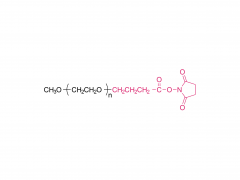
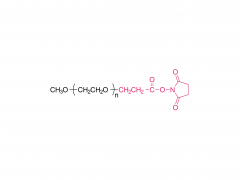
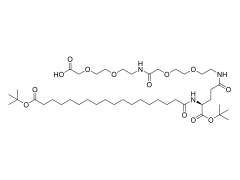
1. Introduction(Structure image)
Hyaluronate Aldehyde (abbreviated as HA-CHO) is an aldehyde-functionalized derivative of hyaluronic acid (HA). By selectively oxidizing hydroxyl groups on the hyaluronic acid backbone, reactive aldehyde groups are introduced, enabling further chemical modification and crosslinking while maintaining the excellent biocompatibility of hyaluronic acid.
Hyaluronic acid (HA) is a naturally occurring linear polysaccharide found in human tissues. It consists of repeating disaccharide units composed of D-glucuronic acid and N-acetyl-D-glucosamine. By introducing aldehyde groups onto the HA backbone, HA-CHO can react with amino groups, hydrazide groups, and aminooxy groups to construct crosslinked hydrogels or composite material systems.
With its excellent hydrophilicity, biocompatibility, and reactive aldehyde functionality, HA-CHO has attracted extensive attention in research fields including tissue engineering, biomaterials, drug delivery, and hydrogel construction.
|
Product Name |
Hyaluronate Aldehyde |
|
Abbreviation |
HA-CHO |
|
Molecular Weight (Mp) |
400,000 |
2. Structural Features and Mechanism
HA-CHO is based on the natural polysaccharide structure of hyaluronic acid and incorporates aldehyde functional groups through chemical modification, combining the intrinsic hydrophilic properties of HA with the reactive capability of aldehyde groups.
1. Aldehyde Functionalization
The aldehyde groups in HA-CHO can react with nucleophilic functional groups, such as amino and hydrazide groups, forming chemical linkages including imine bonds and hydrazone bonds. These reactions provide a foundation for constructing crosslinked polymer networks.
Aldehyde functionalization expands the application potential of hyaluronic acid in the design of functional biomaterials.
2. Hydrophilicity and Biocompatibility
Hyaluronic acid exhibits strong hydrophilicity and can interact with water molecules to form hydrated structures. HA-CHO retains the hydrophilic characteristics of HA while introducing reactive functional sites, providing a suitable material platform for constructing aqueous biological systems.
3. Dynamic Crosslinking Network Formation
The aldehyde groups of HA-CHO can undergo crosslinking reactions with amino-containing functional materials to form hydrogel networks with tunable properties. By adjusting reaction ratios, degree of substitution, molecular weight, and other parameters, the structure and performance of the resulting materials can be further optimized.
4. Functional Modification Capability
HA-CHO can be combined with peptides, proteins, drug molecules, and other polymer materials through conjugation or composite design strategies, providing a foundation for developing multifunctional hyaluronic acid-based materials.
3. Main Applications
1. Biomedical Hydrogels
HA-CHO can serve as a hydrogel-forming material by reacting its aldehyde groups with crosslinkers containing reactive functional groups to generate three-dimensional network structures.
Due to the excellent hydrophilicity and biocompatibility of hyaluronic acid, HA-CHO-based hydrogels can be explored in tissue engineering scaffolds, cell culture matrices, and biomedical material research.
2. Tissue Engineering and Regenerative Materials
Hyaluronic acid is an important component of the extracellular matrix. Through functional modification, HA-CHO can be used to construct biomimetic material systems that provide extracellular matrix-like microenvironments.
In tissue engineering research, HA-CHO can be utilized for developing hydrogel systems, cell-supporting materials, and composite scaffolds for soft tissue regeneration studies.
3. Drug Delivery Systems
HA-CHO can utilize its aldehyde reactivity to construct crosslinked or responsive delivery systems for encapsulating small-molecule drugs, proteins, peptides, and other bioactive substances.
By regulating crosslinking density and network structure, the release behavior of loaded substances can be further controlled, providing a material platform for drug delivery research.
4. Functional Biomaterial Modification
HA-CHO can be combined with gelatin, collagen, polyethylene glycol (PEG), and other functional polymers to construct composite biomaterial systems.
Through material combination and structural design, HA-CHO-based materials can be further explored in biointerfaces, tissue repair, and functional biomaterial research.
5. Cell Culture and 3D Culture Systems
Based on its biocompatibility and tunable crosslinking properties, HA-CHO can be used to construct three-dimensional cell culture environments, providing material support for cell behavior studies and tissue modeling.
4. Related Products
Sinopeg provides various hyaluronic acid-based materials and functionalized hyaluronic acid derivatives for biomedical material research.
|
Product Name |
Abbreviation |
|
Methacrylated Sodium Alginate |
AlgMA |
|
Amino-functionalized Hyaluronic Acid |
HA-NH₂ |
|
Hyaluronate Aldehyde |
HA-CHO |
|
Carboxymethyl Chitosan |
(C6H26N2O10)n |
|
Methacrylated Chitosan |
CSMA |
|
Methacrylated Chondroitin Sulfate |
ChSMA |
|
Methacrylated Silk Fibroin |
SilMA |
|
Methacrylated Hyaluronic Acid |
HAMA |
|
Methacrylated Gelatin |
GelMA |
For more information on functionalized hyaluronic acid and biomedical material products, please visit Sinopeg’s product center.